ESTEBAN ARELLANO
Every morning I walk the same streets in Echo Park. I love this neighborhood but I also know that my loving it is part of what’s killing it.
I moved here after college and by existing here, paying rent here, walking these streets, I contribute to a process displacing the people who built this place and made it worth loving.
I feel it in my body on those morning walks when I pass my neighbors. There’s the older woman bent over her front yard that she has tended to for generations. Another who I pass on his way to open the corner store.
Then there’s the others – the Alo-clad power walkers, heads down, devices up, and a 50-50 shot of whether they’ll even acknowledge our intersection. Echo Park has spent so many years in the grips of these orchestrated community transformations to the point that more people than not fall into this category of neighbors (me included).
A few weeks ago, I wrote about how the attention economy and the ICE raids depend on the same thing: the rest of us being too fragmented, too absorbed, too locked in our own noise to notice what is happening on our own blocks. While our eyes absorb pixels, a profound void surrounds all of us at any given moment, quietly convincing each of us that we are alone.
Lately, I’ve been thinking a lot about this loneliness and how saying hello to your neighbor might be a way to break it.
This question became an investigation during my time in the Social Software Cycle working with artist and educator Lauren McCarthy — a creator of p5.js and someone whose work has always been interested in the places where technology, intimacy, and discomfort converge. The cohort’s premise was deceptively simple: design software for social purposes. Week by week, we built things, tested them, failed, built again.
I started by researching the problem. What I found was that saying hello to someone you pass on the street is actually extraordinarily complicated. The variables are staggering: your sense of safety, the time of day, whether you’re in a hurry, the racial dynamics between you and the person approaching, whether either of you is using a device, the width of the sidewalk, the energy of the block, your mood, your trauma, your communication norms, eye contact or the deliberate avoidance of it. The issue at the heart of these infinite conditions is how to bridge the space of difference between two people.
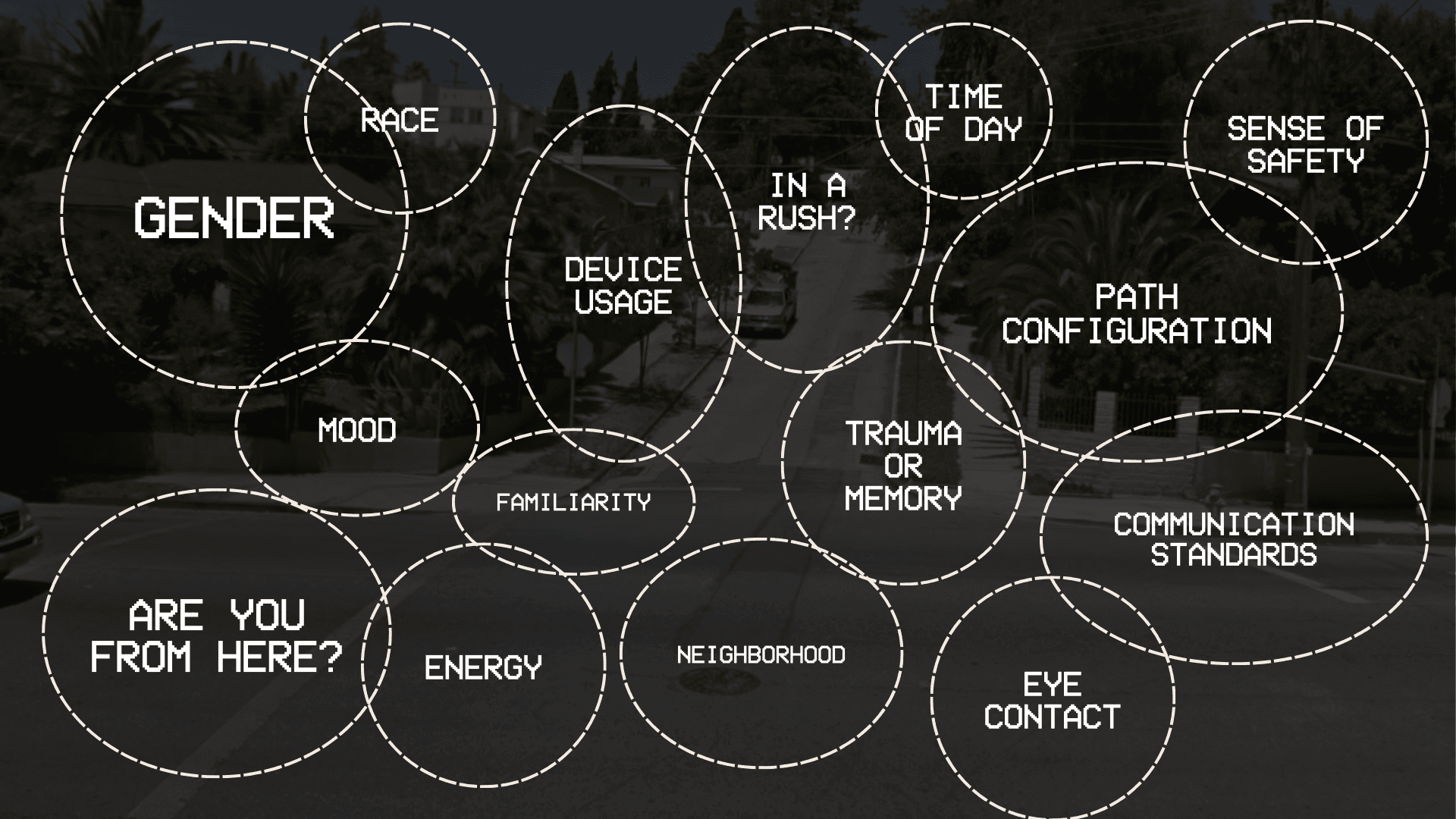
Some of the many factors that shape whether or not we say hello.
My first prototype was called the Neighborhood Rehearsal App. The idea was simple: you’d be on a walk, you’d activate the interface and input how far away a potential greeting partner was, and the app would play you an audio track — my voice, encouraging you, preparing you for the moment of contact. In testing, users told me, consistently, that it was cheeky but didn’t work. The mechanics were clunky. They found themselves staring at their phone at the exact moment they were supposed to be present with another person. The timing was almost never right.
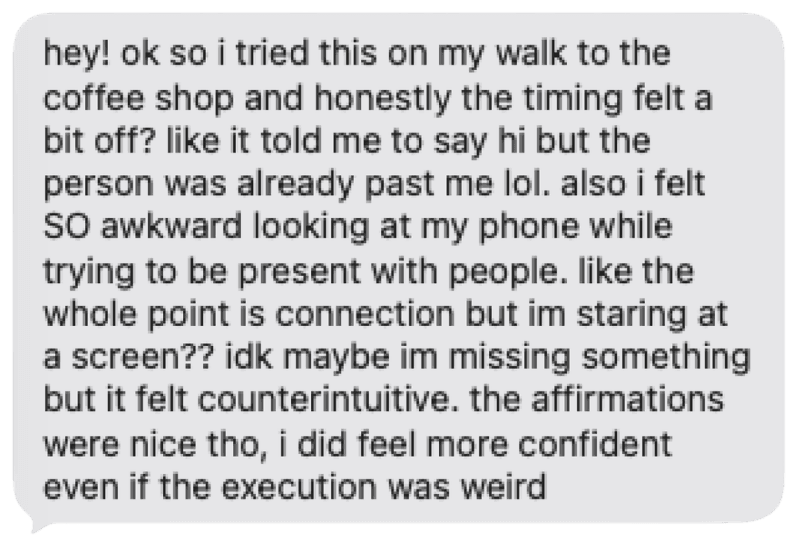
This is the fundamental conundrum: I was solving a problem with technology that technology was partly creating. The same screen pulling people’s attention away from their neighbors was now being asked to bring them back.
So I tried variations. A longer meditation to listen to before the walk rather than during it, drawing on the kind of spoken audio I loved from Ram Das — something that would prime you to be receptive to encounter rather than trying to engineer the encounter itself. Better, but still indirect. Still a device intermediating between me and the person walking toward me.
The trajectory of my prototypes was always toward relinquishing. I had to relinquish the Silicon Valley fantasy that technology can save us from every problem. Or that the dream of a scalable solution, one app that could account for all the infinite conditions of human contact, was possible.
My approach shifted after Lauren first introduced our cohort to Pauline Oliveros.
Oliveros was a queer composer, improviser, and theorist who spent decades finding new ways to make people listen — to sound, to each other, to the world. She came up in the experimental music scene of the 1960s, part of a generation of composers pushing at the edges of what music could be and mean. During the Vietnam War protests at UCSD, where she was teaching, she started writing scores — not conventional musical scores, but text instructions for groups of people to move through together, to share sounds, to attend to what was already in the room. She called them Sonic Meditations.
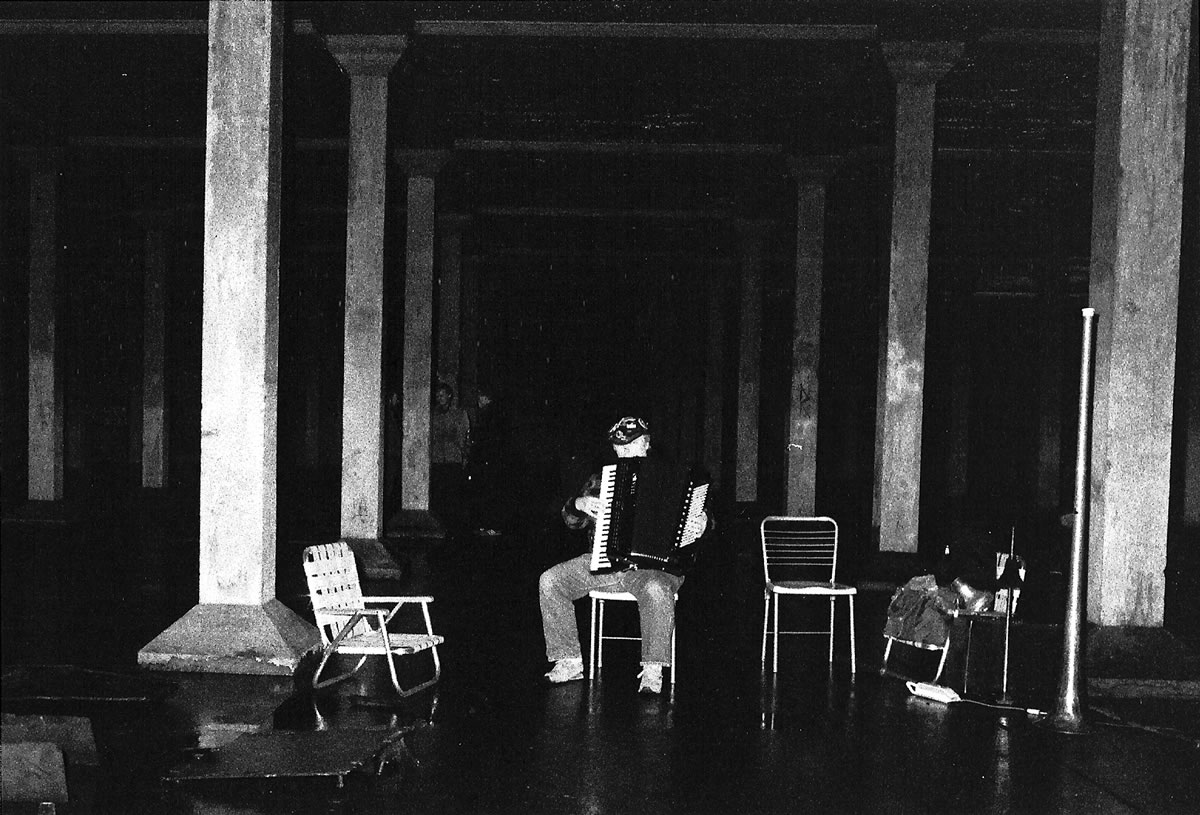
Her concept of deep listening came from a recording she made in 1988 in an underground cistern in Washington — a space with a 45-second reverb, where every sound you made came back to you transformed, delayed, ghostly. Deep listening, as she developed it, was about attuning yourself to the complexity at the edges of your perception, to the frequencies you’ve been trained not to hear. “Deep,” she said, meant the complexity of edges and boundaries you cannot yet fully grasp.
I was struck immediately when Lauren moved us through some of Oliveros’s scores. We did breathing exercises, circulated sounds around the room, let one person’s tone become another’s. I felt connected to my cohort in a way I hadn’t expected. Something about the scores created a container — a set of constraints that laid the groundwork for us to be together.
A team of cognitive scientists have called this feeling synchrony. Natalie Sebanz and her collaborators in Budapest investigated what happens when you ask two strangers to do something as simple as walk together and sync their steps. What they found was that coordinated movement, even brief, even between people with no shared language or cultural reference points, reliably increased feelings of affiliation and empathy between partners. Moving in rhythm with another person, it turns out, does something to how you perceive them — and to how you perceive the people they belong to.
Oliveros and Sebanz point to the same thing: attention is the medium of connection. Whether that attention takes the form of listening or the quiet effort of matching your footfall to a stranger’s, the mechanism is the same. Something shifts when you break out of your own loop long enough to feel someone else’s rhythm.
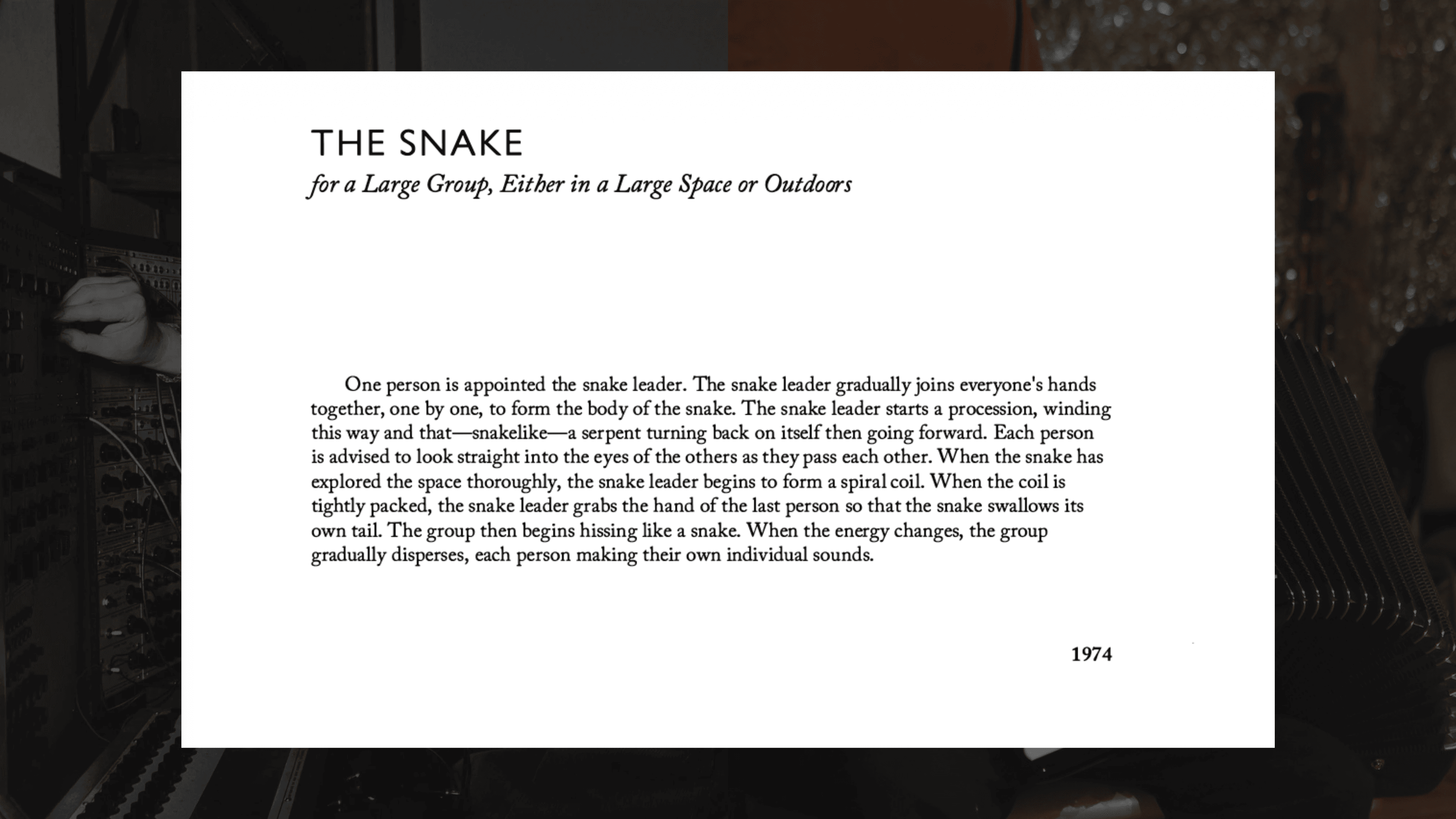
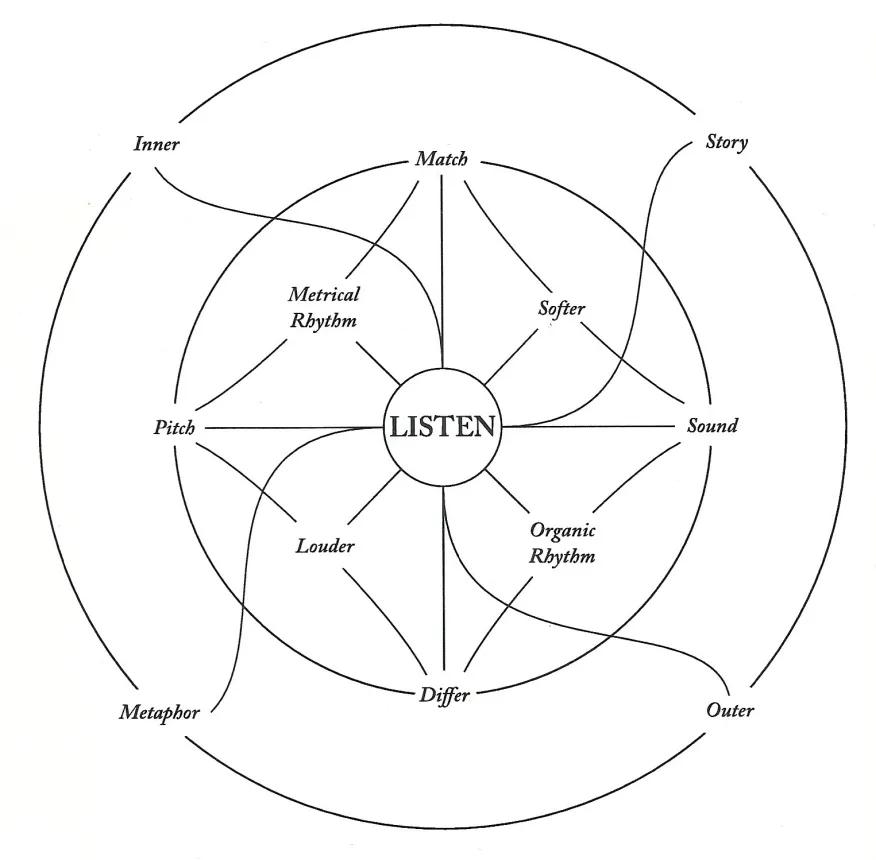
A sample score from Pauline’s book.
Scores enable this shift by creating the structure for improvised connection to blossom. They create constraints small enough to hold — walk in step, pass the sound, breathe together — and inside that constraint, the fog lifts. The mind stops rehearsing itself. The body finds the other person. This is what I kept failing to build with an app, and what Oliveros had already understood decades before anyone was calling it design: the most reliable software for human connection is attention, and that attention can be scored.
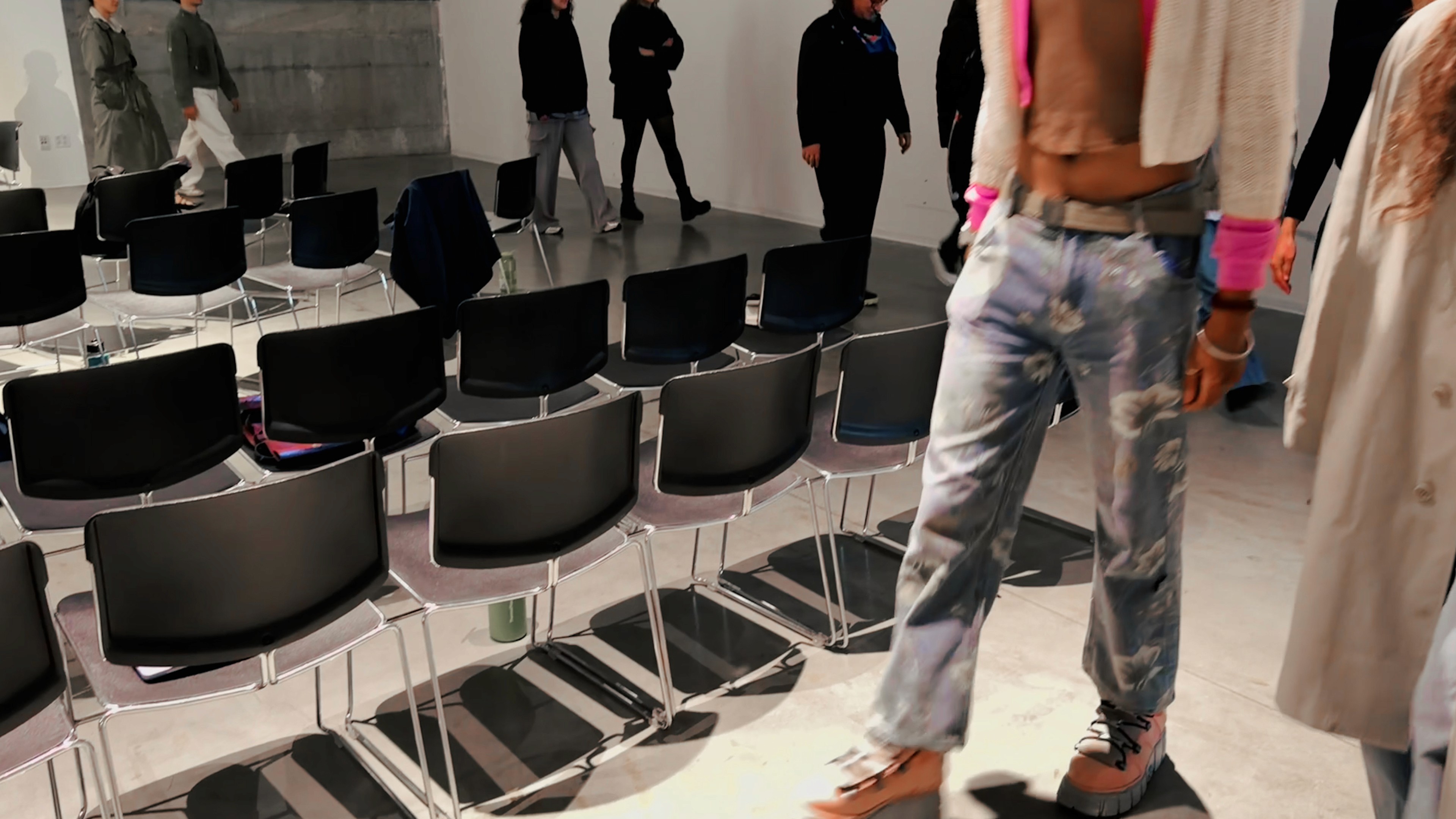
For my final prototype, I designed a score that merged the work of Oliveros and Sebanz. In the UCLA lecture hall, we formed two lines on opposite sides of the chairs. The front person in each line walked to the center and joined their partner from the other line. Together, they walked down the aisle and clockwise around the room, trying to sync their steps.
People who had been strangers thirty seconds earlier were suddenly walking together. While I had been designing for a second of interaction, the synchronized paths opened up a new vision of walking side-by-side. Afterward, one participant said it was less intimidating than talking. You were trying to sync with someone’s movement rather than find the right words, they said.
We found that the verbal dimension of connection often gets in the way of connecting. When you reduce the infinite parameters of human encounter to one manageable instruction, the body knows what to do. You find the other person.
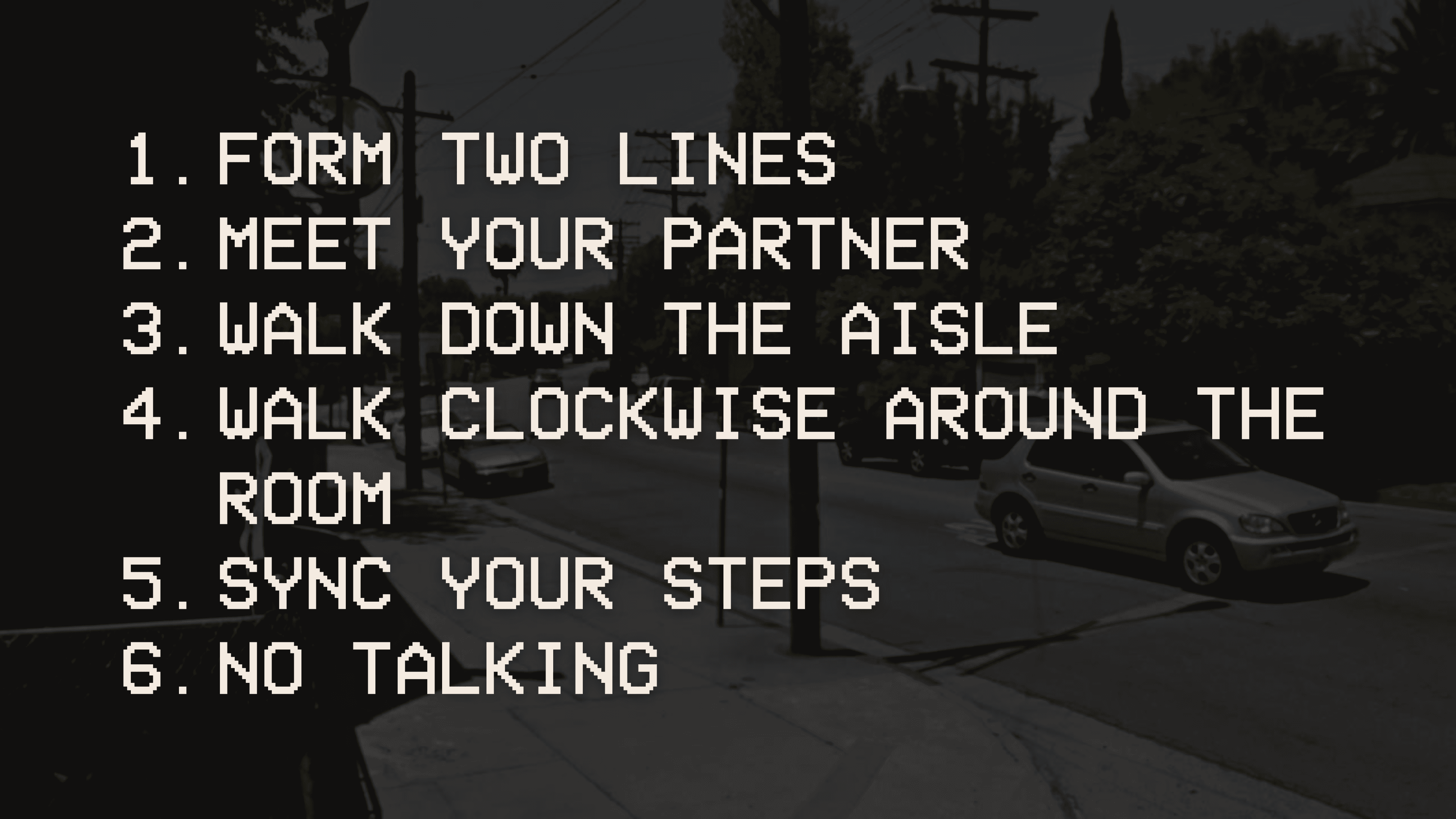
The score shared during the experience.
What do we stand to gain from saying hello? Less than you might hope, and more than you’d think.
Less, because a hello does not stop a city from gentrifying. It doesn’t undo displacement or redistribute wealth or change who can afford to stay. I want to be clear about this because the appeal of embodied, relational practices like these can function as a kind of alibi, a way of feeling like we’re doing something about structural conditions that require structural responses.
But more, because what erodes in a gentrifying neighborhood, alongside affordability and community and cultural continuity, is the texture of daily acknowledgment — the small rituals that tell people they are seen, that they belong to this place, that someone notices them moving through it. The dance of avoidance I described at the beginning of this essay is part of how displacement works, how people are made to feel that they do not belong. Saying hello is not a solution. But it is a small, repeatable, public refusal of the isolation that power depends on. And I think the jump across the space between you and me — however awkward, however imperfect — is a skill worth practicing if we ever want to feel more at home with each other.
I’m spending this year trying to understand what it would take to forge more connected neighborhoods IRL and online. This work can only go so far in the private laboratory of the university. Over the next year, I will be developing these scores into group gatherings across Los Angeles and the Internet. I’m interested in how these scores must adapt across neighborhoods and how they can be used to gather people who don’t often walk alongside each other.
This is social software. While Silicon Valley technology thrives on hedonistic fantasies of ultimate scale, this is something smaller. Saying hello is a ritual against our alienation. A set of scores designed for public space — the sidewalk, the corner store, the park — that take seriously both the constraints of the real world and the body’s capacity to find another person inside them.
If you want to be part of this — as a participant, a collaborator, a skeptic, or someone who has been thinking about their own neighborhood and what it would take to say hello — I’d love to hear from you.
Every morning I walk the same streets in Echo Park. I love this neighborhood but I also know that my loving it is part of what’s killing it.
I moved here after college and by existing here, paying rent here, walking these streets, I contribute to a process displacing the people who built this place and made it worth loving.
I feel it in my body on those morning walks when I pass my neighbors. There’s the older woman bent over her front yard that she has tended to for generations. Another who I pass on his way to open the corner store.
Then there’s the others – the Alo-clad power walkers, heads down, devices up, and a 50-50 shot of whether they’ll even acknowledge our intersection. Echo Park has spent so many years in the grips of these orchestrated community transformations to the point that more people than not fall into this category of neighbors (me included).
A few weeks ago, I wrote about how the attention economy and the ICE raids depend on the same thing: the rest of us being too fragmented, too absorbed, too locked in our own noise to notice what is happening on our own blocks. While our eyes absorb pixels, a profound void surrounds all of us at any given moment, quietly convincing each of us that we are alone.
Lately, I’ve been thinking a lot about this loneliness and how saying hello to your neighbor might be a way to break it.
This question became an investigation during my time in the Social Software Cycle working with artist and educator Lauren McCarthy — a creator of p5.js and someone whose work has always been interested in the places where technology, intimacy, and discomfort converge. The cohort’s premise was deceptively simple: design software for social purposes. Week by week, we built things, tested them, failed, built again.
I started by researching the problem. What I found was that saying hello to someone you pass on the street is actually extraordinarily complicated. The variables are staggering: your sense of safety, the time of day, whether you’re in a hurry, the racial dynamics between you and the person approaching, whether either of you is using a device, the width of the sidewalk, the energy of the block, your mood, your trauma, your communication norms, eye contact or the deliberate avoidance of it. The issue at the heart of these infinite conditions is how to bridge the space of difference between two people.
Some of the many factors that shape whether or not we say hello.
My first prototype was called the Neighborhood Rehearsal App. The idea was simple: you’d be on a walk, you’d activate the interface and input how far away a potential greeting partner was, and the app would play you an audio track — my voice, encouraging you, preparing you for the moment of contact. In testing, users told me, consistently, that it was cheeky but didn’t work. The mechanics were clunky. They found themselves staring at their phone at the exact moment they were supposed to be present with another person. The timing was almost never right.
This is the fundamental conundrum: I was solving a problem with technology that technology was partly creating. The same screen pulling people’s attention away from their neighbors was now being asked to bring them back.
So I tried variations. A longer meditation to listen to before the walk rather than during it, drawing on the kind of spoken audio I loved from Ram Das — something that would prime you to be receptive to encounter rather than trying to engineer the encounter itself. Better, but still indirect. Still a device intermediating between me and the person walking toward me.
The trajectory of my prototypes was always toward relinquishing. I had to relinquish the Silicon Valley fantasy that technology can save us from every problem. Or that the dream of a scalable solution, one app that could account for all the infinite conditions of human contact, was possible.
My approach shifted after Lauren first introduced our cohort to Pauline Oliveros.
Oliveros was a queer composer, improviser, and theorist who spent decades finding new ways to make people listen — to sound, to each other, to the world. She came up in the experimental music scene of the 1960s, part of a generation of composers pushing at the edges of what music could be and mean. During the Vietnam War protests at UCSD, where she was teaching, she started writing scores — not conventional musical scores, but text instructions for groups of people to move through together, to share sounds, to attend to what was already in the room. She called them Sonic Meditations.
Her concept of deep listening came from a recording she made in 1988 in an underground cistern in Washington — a space with a 45-second reverb, where every sound you made came back to you transformed, delayed, ghostly. Deep listening, as she developed it, was about attuning yourself to the complexity at the edges of your perception, to the frequencies you’ve been trained not to hear. “Deep,” she said, meant the complexity of edges and boundaries you cannot yet fully grasp.
I was struck immediately when Lauren moved us through some of Oliveros’s scores. We did breathing exercises, circulated sounds around the room, let one person’s tone become another’s. I felt connected to my cohort in a way I hadn’t expected. Something about the scores created a container — a set of constraints that laid the groundwork for us to be together.
A team of cognitive scientists have called this feeling synchrony. Natalie Sebanz and her collaborators in Budapest investigated what happens when you ask two strangers to do something as simple as walk together and sync their steps. What they found was that coordinated movement, even brief, even between people with no shared language or cultural reference points, reliably increased feelings of affiliation and empathy between partners. Moving in rhythm with another person, it turns out, does something to how you perceive them — and to how you perceive the people they belong to.
Oliveros and Sebanz point to the same thing: attention is the medium of connection. Whether that attention takes the form of listening or the quiet effort of matching your footfall to a stranger’s, the mechanism is the same. Something shifts when you break out of your own loop long enough to feel someone else’s rhythm.
A sample score from Pauline’s book.
Scores enable this shift by creating the structure for improvised connection to blossom. They create constraints small enough to hold — walk in step, pass the sound, breathe together — and inside that constraint, the fog lifts. The mind stops rehearsing itself. The body finds the other person. This is what I kept failing to build with an app, and what Oliveros had already understood decades before anyone was calling it design: the most reliable software for human connection is attention, and that attention can be scored.
For my final prototype, I designed a score that merged the work of Oliveros and Sebanz. In the UCLA lecture hall, we formed two lines on opposite sides of the chairs. The front person in each line walked to the center and joined their partner from the other line. Together, they walked down the aisle and clockwise around the room, trying to sync their steps.
People who had been strangers thirty seconds earlier were suddenly walking together. While I had been designing for a second of interaction, the synchronized paths opened up a new vision of walking side-by-side. Afterward, one participant said it was less intimidating than talking. You were trying to sync with someone’s movement rather than find the right words, they said.
We found that the verbal dimension of connection often gets in the way of connecting. When you reduce the infinite parameters of human encounter to one manageable instruction, the body knows what to do. You find the other person.
The score shared during the experience.
What do we stand to gain from saying hello? Less than you might hope, and more than you’d think.
Less, because a hello does not stop a city from gentrifying. It doesn’t undo displacement or redistribute wealth or change who can afford to stay. I want to be clear about this because the appeal of embodied, relational practices like these can function as a kind of alibi, a way of feeling like we’re doing something about structural conditions that require structural responses.
But more, because what erodes in a gentrifying neighborhood, alongside affordability and community and cultural continuity, is the texture of daily acknowledgment — the small rituals that tell people they are seen, that they belong to this place, that someone notices them moving through it. The dance of avoidance I described at the beginning of this essay is part of how displacement works, how people are made to feel that they do not belong. Saying hello is not a solution. But it is a small, repeatable, public refusal of the isolation that power depends on. And I think the jump across the space between you and me — however awkward, however imperfect — is a skill worth practicing if we ever want to feel more at home with each other.
I’m spending this year trying to understand what it would take to forge more connected neighborhoods IRL and online. This work can only go so far in the private laboratory of the university. Over the next year, I will be developing these scores into group gatherings across Los Angeles and the Internet. I’m interested in how these scores must adapt across neighborhoods and how they can be used to gather people who don’t often walk alongside each other.
This is social software. While Silicon Valley technology thrives on hedonistic fantasies of ultimate scale, this is something smaller. Saying hello is a ritual against our alienation. A set of scores designed for public space — the sidewalk, the corner store, the park — that take seriously both the constraints of the real world and the body’s capacity to find another person inside them.
If you want to be part of this — as a participant, a collaborator, a skeptic, or someone who has been thinking about their own neighborhood and what it would take to say hello — I’d love to hear from you.
Play with me on Are.na
Let's talk – estebangarellano at gmail dot com
Play with me on Are.na
Let's talk – estebangarellano at gmail dot com
Play with me on Are.na
Let's talk – estebangarellano@gmail.com